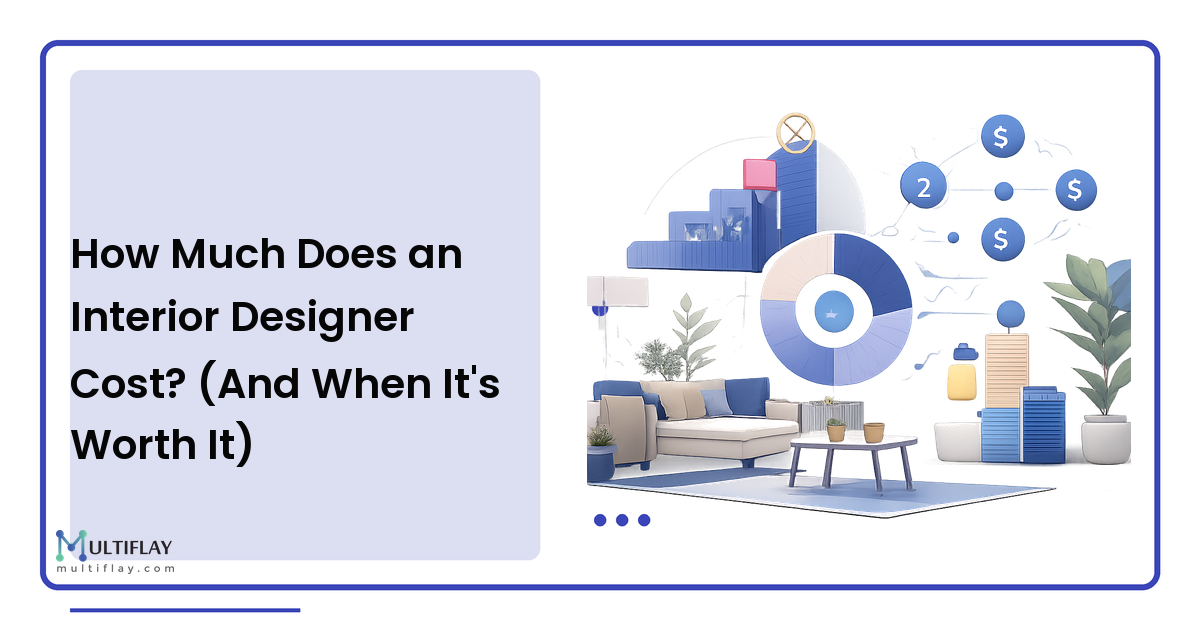
The honest answer to "how much does an interior designer cost" is that it depends far less on the designer's talent than on how they charge and how much of the work you hand them. The same living room can cost a few hundred dollars in one-off advice or many thousands in full-service design that runs from floor plan to the last cushion — and either can be the right call, depending on your project.
Here is the takeaway up front: interior designers use a handful of standard pricing models, and once you understand them you can predict the cost, compare quotes fairly, and decide whether the outcome justifies the fee. Below are the models, honest typical ranges, what pushes the price up or down, and when hiring a designer pays off — and when you're better off doing it yourself.
The five ways interior designers charge
Almost every designer bills in one of these five structures. The number on your invoice depends more on which one you're under than on anything else.
| Pricing model | How it works | Best for | Watch out for |
|---|---|---|---|
| Hourly | You pay for time, typically ~$75–$250/hr (higher for sought-after names) | Small, defined jobs; consultations; questions you can't answer yourself | Open-ended totals — hours add up fast without a cap |
| Flat / fixed fee | One agreed price for a defined scope, often quoted per room | Clear, contained projects where you want a predictable number | Anything outside the original scope becomes an extra |
| Cost-plus | Designer buys furnishings at trade pricing and adds a markup (commonly ~15–35%) | Furnishing-heavy projects where trade access saves you money | Incentive to spec pricier pieces — ask for itemized costs |
| Percentage of project | Fee is a share of the total budget (commonly ~10–30%) | Renovations and new builds with large construction budgets | Bigger budget means a bigger fee — clarify what's included |
| Per square foot | Fee scales with the area being designed | Large homes and new construction | Less common; make sure it maps to actual work, not just size |
A growing sixth option, e-design (virtual design), delivers a room concept, layout, and shopping list remotely for a flat per-room fee — commonly around $75 to $1,500 a room. You do the buying and the physical work. It's the budget end of the market — a genuinely good fit for confident DIYers who mainly need a plan.
(Figures are typical U.S. ranges that vary widely by region, experience, and scope — orientation, not quotes.)
So what does it actually cost?
Because the models differ so much, the useful way to think about cost is by level of service, not a single average:
- A one-time consultation — a designer walks your space, diagnoses what's wrong, and points you in a direction, usually billed hourly or as a small flat fee (a couple hundred to several hundred dollars). Often the highest-value, lowest-cost place to start.
- A single-room design — a full plan for one room (layout, palette, furnishings, sourcing) commonly runs into the low-to-mid thousands in fees, before furnishings. E-design lands well below that; a senior local designer well above.
- Whole-home or full-service design — layout, procurement, and project management across a house is where fees reach five figures: you're buying months of coordination, not just ideas.
- Renovation-integrated design — when a designer steers construction decisions alongside a contractor, expect percentage-of-project or hourly billing, and budget the design fee on top of the build.
Two costs are easy to forget: the furnishings themselves (the fee is separate from the sofa) and revisions beyond the included rounds — always ask how many a fee covers.
What drives the price up or down
Same room, very different quotes — usually because of these variables:
- Experience and demand. A designer with a waitlist and a published portfolio charges a multiple of what a newer one does — sometimes for judgment that prevents costly mistakes, sometimes just for the name. Look at the work, not the reputation.
- Your market. Rates in a major metro can run double a smaller city for identical scope.
- Scope and service level. Advice-only is cheap; full-service — sourcing everything, managing trades, handling delivery and install — is expensive because it's a project-management job, not a styling one.
- Procurement. If the designer buys for you, a cost-plus markup or commission enters the picture — which can still save money through trade discounts, but only if it's transparent.
- Custom vs. off-the-shelf. Bespoke cabinetry and made-to-order pieces raise both the fee and the furnishings bill.
Interior designer vs. decorator vs. e-design
These aren't interchangeable, and matching the right one to your project is the single biggest cost lever you control.
- Interior designer — trained in space planning and often able to work on structural and building decisions (moving walls, lighting plans, coordinating with architects and contractors). Hire one when the bones of the space are in play.
- Interior decorator — focuses on the surface layer: furniture, color, textiles, and styling, with no structural work. Usually a lower fee, and the right call when the layout stays put and you just need the room to feel finished.
- E-design service — a remote plan you execute yourself. The cheapest path, and excellent if you're comfortable ordering, assembling, and arranging on your own.
If you don't need walls moved, you may not need a full-service designer at all — and recognizing that can save you thousands.
Is hiring an interior designer worth it?
Honestly, sometimes it isn't. Here's the clear version of both sides.
It's usually worth it when:
- The budget is large enough that a mistake is expensive. Getting the layout, scale, or a big furniture order wrong can cost more than the entire fee — the math that makes designers pay for themselves.
- You're renovating or moving walls, where spatial and lighting decisions are hard to reverse.
- You have no time, or you've stalled out in analysis paralysis and nothing is getting done.
- You want trade access and coordination — one person owning sourcing, ordering, and install.
You can confidently skip it when:
- It's a single room, cosmetic, and you enjoy the process.
- Your budget is tight and the fee would eat the furnishings money.
- You mostly need a starting direction — in which case a one-hour paid consultation or an e-design plan gives you 80% of the value for a fraction of the cost.
There's a middle path many people miss: do the fundamentals yourself and buy expertise only where it's hardest. If you want to try the DIY route first, our interior design fundamentals guide walks through layout, light, and color in order — and a paid consultation later can pressure-test your plan before you spend on furniture.
How to hire without overpaying
Whichever way you go, these steps keep the number honest:
- Define your scope in writing first. "Design my living and dining room, layout plus furnishings" gets a real quote; "help with my house" gets a vague, padded one.
- Ask which pricing model they use — and get it in writing. Hourly, flat, cost-plus, or percentage. Then ask what happens when scope changes.
- Ask what's included. Procurement? Project management? Site visits? How many revision rounds? The gaps between those lines are where surprise costs live.
- Start with a paid consultation. It's a low-risk way to test fit and often delivers enough direction on its own.
- Insist on markup transparency. With cost-plus, ask to see itemized product costs so you know what's fee and what's furniture.
FAQ
How much does an interior designer cost per room?
It varies with service level. A remote e-design plan for one room can run from roughly $75 to $1,500, while a full local single-room design — layout, sourcing, and management — commonly reaches the low-to-mid thousands in fees before furnishings. A one-time consultation to point you in the right direction is the cheapest entry point.
Do interior designers actually save you money?
Sometimes, but it isn't guaranteed. They can save money through trade discounts on furnishings and by preventing costly mistakes — a wrongly sized sofa or a layout that doesn't work is expensive to redo. On a small cosmetic project, though, the fee can outweigh those savings, which is why matching the service level to the job matters so much.
What's the difference between an interior designer and a decorator?
A designer is trained in space planning and can work on structural and building decisions — moving walls, lighting plans, coordinating with contractors. A decorator focuses on the surface layer: furniture, color, and styling, with no structural work, usually at a lower fee. Choose a designer when the layout or bones are changing; a decorator when they aren't.
Is an online (e-design) service cheaper than a local designer?
Almost always, because you supply the labor — the ordering, assembly, and arranging. You get a professional plan and shopping list for a flat per-room fee, then execute it yourself. It's an excellent value if you're a confident DIYer, and a poor fit if you want someone to manage the whole project hands-on.
Is hiring an interior designer worth it for just one room?
It can be, if that room is high-stakes or you're stuck — but for a single cosmetic room on a tight budget, a paid consultation or e-design plan usually delivers most of the value for far less. Reserve full-service design for projects where the cost of getting it wrong is bigger than the fee.
Next step
Cost is really a question of scope: decide how much of the work you want to own, pick the pricing model that fits, and get what's included in writing before anyone starts. Do that and the fee stops being a mystery and becomes a decision you can actually weigh.
And if you decide expert help is worth it — someone to get the layout, light, and materials right the first time and manage the parts you'd rather not — that's exactly what we do. See how we approach design that enhances the way you live at multiflay.com.